
Herbicides, Baseline 915 EC
Baseline Herbicide: Uses, Application Rates and Weed Control Guide
Aug
Learn about Baseline Herbicide, including its uses, recommended application rates, weeds controlled, suitable crops, application timing and essential weed control practices.
Introduction to Baseline Herbicide
Effective weed control is an essential part of successful crop production. Weeds compete with crops for water, nutrients, sunlight and growing space, particularly during the critical early stages of crop development. A well-planned herbicide programme can help reduce this competition and support healthier crop establishment.
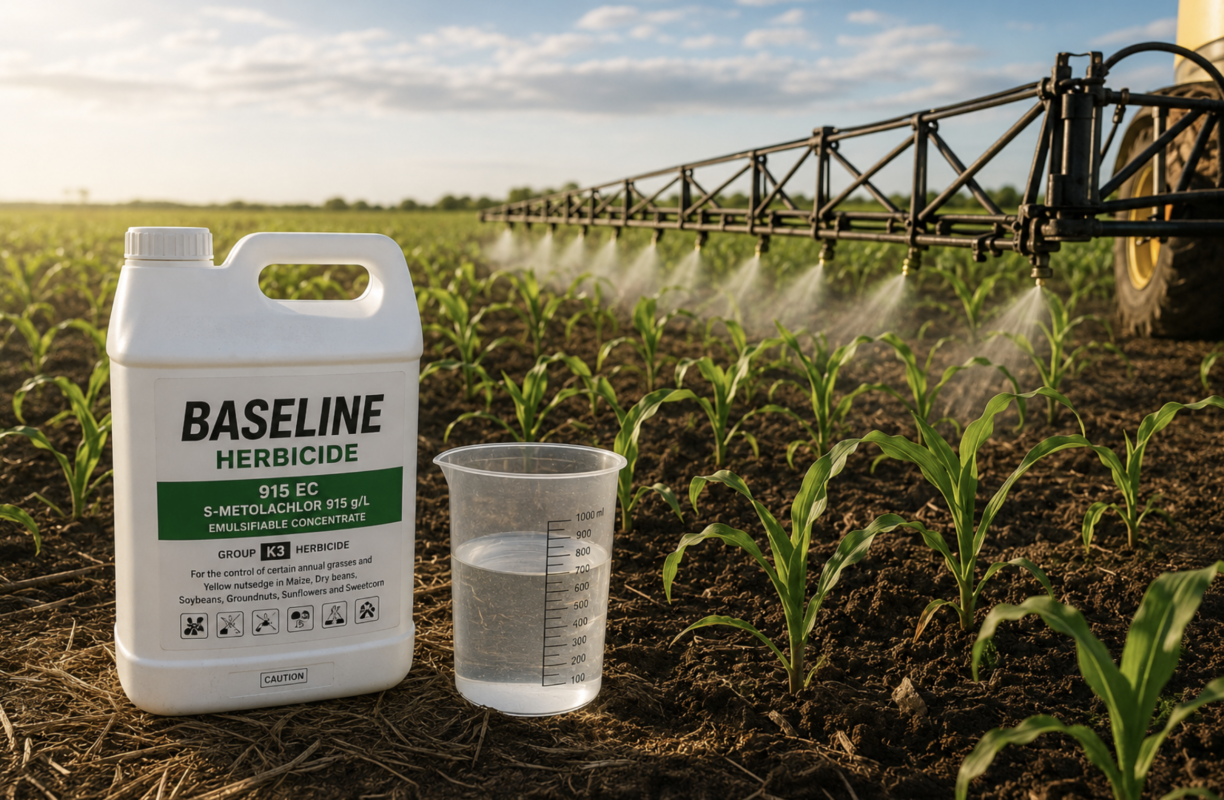
Baseline Herbicide is a product name associated with herbicide formulations used for agricultural weed control. In South Africa, BASELINE 915 EC is an emulsifiable concentrate containing 915 g/L S-metolachlor and is registered for pre-emergence control of annual grasses and, under certain conditions, Yellow nutsedge in specified crops. The product information identifies crops including maize, dry beans, groundnuts, soybeans, sunflowers and sweetcorn.
This guide focuses on the South African BASELINE 915 EC product. Always confirm the exact formulation, registration, approved crop and current label before use, as herbicide products with similar names may differ between countries and formulations.
What Is Baseline Herbicide?
Baseline 915 EC is a pre-emergence herbicide designed primarily to control certain annual grass weeds and provide control of Yellow nutsedge under the conditions specified on the registered label. It contains S-metolachlor and is formulated as an emulsifiable concentrate.
Pre-emergence herbicides are generally applied to the soil at the appropriate time to control susceptible weeds as they germinate and emerge. This makes correct application timing particularly important. Soil preparation, moisture, weed pressure, crop type and soil characteristics can all influence herbicide performance.
According to the South African product information, BASELINE 915 EC is intended for agricultural use in crops such as:
- Maize
- Dry beans
- Soybeans
- Groundnuts
- Sunflowers
- Sweetcorn
The exact registered uses and restrictions should always be confirmed from the latest product label before application.
Uses of Baseline Herbicide
The primary purpose of Baseline Herbicide is to form part of an integrated weed management programme. It is particularly relevant where annual grass weeds create strong competition with newly established crops.
Early-season weed competition can reduce the ability of crops to establish vigorous root systems and access available moisture and nutrients. A pre-emergence programme may therefore be used to reduce the initial flush of susceptible weeds before they become established.
Weed Control Applications
Depending on the registered use, Baseline 915 EC is associated with the control of various annual grasses. The product label information includes weeds such as:
- Sweet signal grass
- Feather top Chloris
- Nettle-leaved goosefoot
- Crowfoot
- Crab finger-grass
- Barnyard grass
- African goosegrass
- Sweet buffalo grass
- Common buffalo grass
- Red bristle grass
- Other listed susceptible weeds
The label also provides specific information relating to Yellow nutsedge control under certain conditions. Weed species, population density, soil type, rainfall and application timing can all affect the final level of control.
For this reason, farmers should correctly identify the dominant weed species in the field before selecting a herbicide programme.
How Does Baseline Herbicide Work?
As a pre-emergence herbicide, Baseline 915 EC is intended to be used according to label directions to provide residual weed control in the soil. Successful performance depends on placing the herbicide correctly and ensuring conditions are suitable for weed control.
Several factors may influence results:
1. Soil Type
Soil texture and clay content can affect the recommended application rate. Lighter soils may require a different rate from heavier soils, while soil organic matter can also influence herbicide behaviour.
2. Soil Moisture
Adequate moisture is important for many pre-emergence herbicide programmes. The official label contains specific guidance on timing and moisture conditions, including recommendations relating to application into suitable soil conditions.
3. Weed Pressure
Fields with heavy infestations of certain weeds may require the higher rate within the registered range. However, the applicable rate must always be selected according to the product label and the relevant crop.
4. Application Timing
Pre-emergence herbicides must be applied at the correct stage of the crop and weed development. Applying too late may result in reduced control of weeds that have already emerged.
Baseline Herbicide Application Rates
One of the most common questions from growers is: What is the application rate for Baseline Herbicide?
The answer depends on several factors, including:
- The exact Baseline formulation
- The crop being treated
- Soil texture and clay percentage
- Soil organic matter
- Target weed species
- Weed infestation level
- Application method
- The current registered product label
For BASELINE 915 EC, official South African label information provides crop- and soil-specific rates. For dry beans and soybeans, the label information includes the following ranges:
| Soil Type / Clay Content | BASELINE 915 EC Rate |
|---|---|
| Sand, loamy sand and sandy loam, 0–20% clay | 0.6–0.8 L/ha |
| Sandy clay loam, 21–30% clay | 0.8–1.0 L/ha |
| Heavier soils, above 30% clay | 1.0–1.3 L/ha |
The higher rate within the applicable range may be indicated under the label for specific situations, including improved control of Yellow nutsedge, heavy infestations of Crab finger-grass or certain higher organic matter conditions. These rates are product-specific and must not be transferred to a different Baseline formulation or another herbicide.
Important: Application rates can change according to crop, formulation and label registration. Always read the latest approved label before mixing or applying any herbicide.
How to Apply Baseline Herbicide Effectively
Correct application is just as important as selecting the right product.
Prepare a Suitable Seedbed
A well-prepared seedbed can help support more even herbicide distribution. Large clods, excessive crop residue or uneven soil surfaces may affect the placement of a pre-emergence treatment.
Apply at the Correct Time
Follow the label instructions for the relevant crop and application programme. Timing is critical because the herbicide is intended to provide control during the appropriate stage of weed germination and emergence.
Consider Soil Moisture
Rainfall or irrigation requirements should be assessed according to the official product label. The BASELINE 915 EC label includes specific instructions concerning soil moisture and rainfall for optimum performance in certain situations.
Use Properly Calibrated Equipment
Sprayers should be correctly calibrated to ensure that the selected amount of product is distributed evenly across the target area. Uneven application can lead to poor weed control in some areas and unnecessary crop risk in others.
Avoid Spray Drift
Herbicides should be applied only under suitable weather conditions and with equipment configured to minimise off-target movement. Wind, nozzle selection, boom height and droplet size can all influence spray drift.
Baseline Herbicide for Maize
Maize producers face significant competition from annual grass weeds, especially during early crop establishment. A pre-emergence herbicide programme can help manage susceptible weeds before they become established.
BASELINE 915 EC is listed for use in maize, subject to the registered label directions. The exact rate and application programme depend on factors including soil type, crop system and target weeds.
Growers should not assume that one rate is suitable for every maize field. A sandy field and a heavier clay soil may require different approaches according to the label.
Baseline Herbicide for Soybeans and Dry Beans
Soybeans and dry beans can be particularly vulnerable to early weed competition. Maintaining a cleaner field during establishment can support stronger crop development.
For dry beans and soybeans, the official BASELINE 915 EC label provides different application rate ranges based on soil texture and clay percentage. The published range extends from 0.6 L/ha to 1.3 L/ha for the referenced soil categories, with higher rates within the approved range used under specified conditions.
Because beans can be sensitive to incorrect herbicide use, growers should pay particular attention to:
- Crop registration
- Soil type
- Planting conditions
- Application timing
- Product compatibility
- Crop rotation restrictions
- The latest approved label
Common Mistakes to Avoid
Even a quality herbicide may deliver disappointing results when it is applied incorrectly. Common mistakes include:
Using the Wrong Rate
Never estimate the application rate. Rates must be calculated according to the exact formulation, crop and field conditions described on the label.
Applying Too Late
Pre-emergence products are not a substitute for every post-emergence weed control requirement. Weeds that have already emerged may require a different management strategy.
Ignoring Soil Conditions
Clay content, organic matter and moisture can affect herbicide recommendations and performance.
Poor Sprayer Calibration
An incorrectly calibrated sprayer can result in uneven coverage and inconsistent weed control.
Ignoring the Product Label
The herbicide label is a legal and technical document that provides important information on approved crops, application rates, safety precautions, compatibility and use restrictions.
Herbicide Safety and Personal Protective Equipment
All agricultural chemicals should be handled responsibly. Before using Baseline Herbicide, read the current product label and Safety Data Sheet.
Appropriate safety procedures may include the use of suitable:
- Protective gloves
- Protective clothing
- Eye and face protection
- Appropriate footwear
- Respiratory protection where required by the product instructions and risk assessment
Avoid contamination of water sources, food, animal feed and areas not intended for treatment. Store agricultural chemicals securely in accordance with applicable regulations and manufacturer instructions.
The official product information and Safety Data Sheet should be consulted for the specific safety requirements of BASELINE 915 EC.
Building an Effective Weed Control Programme
Baseline Herbicide can be most effective when used as part of a broader weed management strategy rather than as the only method of weed control.
An integrated programme may include:
- Accurate weed identification
- Crop rotation
- Suitable cultivation practices
- Correct herbicide timing
- Pre-emergence and post-emergence strategies where registered
- Rotation of herbicide modes of action
- Regular field monitoring
Rotating weed control strategies can also help reduce dependence on a single herbicide approach.
Frequently Asked Questions About Baseline Herbicide
What is Baseline Herbicide used for?
In South Africa, BASELINE 915 EC is used as a pre-emergence herbicide for the control of specified annual grass weeds and, under certain conditions, Yellow nutsedge in registered crops.
What is the application rate for Baseline Herbicide?
The rate depends on the crop, soil type and exact product formulation. For BASELINE 915 EC, published label information for dry beans and soybeans includes rates from 0.6 to 1.3 L/ha, depending on soil clay content and other specified conditions.
Can Baseline Herbicide be used on maize?
BASELINE 915 EC is listed for use on maize, subject to the directions, restrictions and application recommendations on the current South African product label.
Does Baseline Herbicide control weeds that have already emerged?
Baseline 915 EC is primarily a pre-emergence herbicide. Existing emerged weeds may require a different registered control strategy.
Why is soil type important?
Soil characteristics, including clay content and organic matter, can affect the recommended application rate and herbicide performance.
Conclusion
Baseline Herbicide can be an important component of an agricultural weed control programme when the correct product, application timing and registered rate are selected. In South Africa, BASELINE 915 EC is a pre-emergence herbicide containing 915 g/L S-metolachlor and is registered for use on specified crops, including maize, dry beans, soybeans, groundnuts, sunflowers and sweetcorn.
The most important rule for successful application is to avoid treating herbicide rates as universal. Soil type, crop, weed pressure, moisture conditions and the exact formulation all matter. Always consult the latest approved label and product safety information before use.
By combining correct herbicide selection with proper application, accurate weed identification, calibrated equipment and good agricultural practices, growers can build a more effective and responsible weed management programme.