
Silver mercury
Mercury Price Forecast 2026
Aug
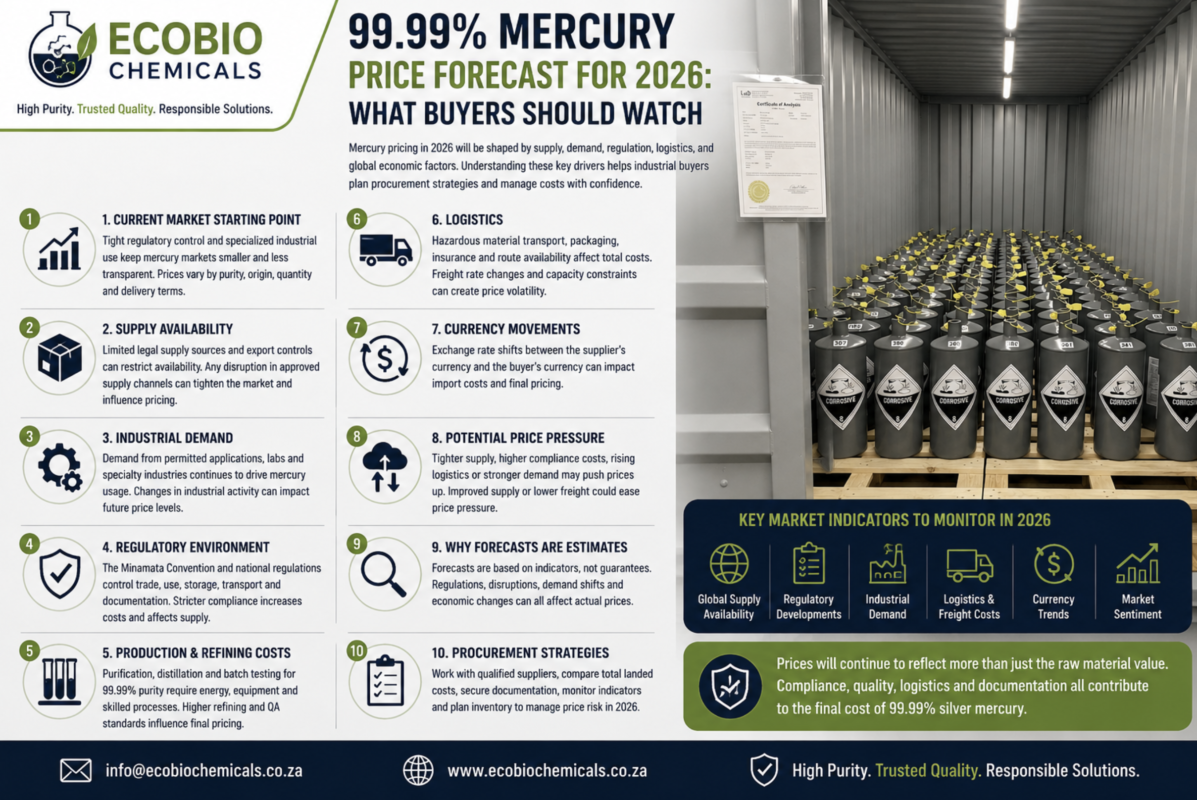
99.99% Mercury Price Forecast 2026: What Buyers Should Watch
For industrial buyers researching the mercury price forecast 2026, it is important to distinguish between market indicators and guaranteed prices. Mercury is not a conventional freely traded commodity with one universally applicable price. The cost of 99.99% liquid mercury can vary according to purity, origin, availability, regulatory requirements, logistics, documentation, order size, currency, and destination.
Rather than predicting a specific price, a useful mercury market forecast should examine the factors most likely to influence procurement costs throughout 2026.
1. Current Market Starting Point
The starting point for any mercury price outlook is the existing balance between legally available supply, industrial demand, regulatory requirements, and logistics.
Mercury is subject to significant international environmental and trade controls. The Minamata Convention on Mercury establishes measures relating to supply sources and international trade, making regulatory considerations an important part of the commercial market.
For buyers, this means that a quoted price should always be considered in context. A supplier’s price may represent a particular purity, packaging configuration, delivery term, documentation package, and regulatory arrangement rather than a universal market price.
Therefore, an online “mercury price per kilogram” should not automatically be treated as a benchmark for every industrial transaction.
2. Supply Availability
Supply availability is one of the most important variables to monitor during 2026.
The mercury market differs from many conventional industrial-material markets because international rules can influence which sources and transactions are permissible. Restrictions on supply sources and international trade can affect the number of suppliers able to serve particular destinations.
For industrial procurement teams, the practical question is therefore not simply how much mercury exists globally, but how much material is legally available, appropriately documented, and commercially accessible for a particular application and destination.
Changes in supply availability can influence quotation levels, lead times, and the number of competing offers available to buyers.
3. Industrial Demand
Demand is another important component of the mercury market forecast.
Mercury continues to have specialized industrial and technical applications, although regulatory policies have reduced or restricted certain uses in many markets. Changes in manufacturing activity, laboratory requirements, specialized industrial processes, and other permitted applications can influence demand.
However, demand should not be considered independently from regulation. A sector may experience strong underlying demand while still facing restrictions on mercury use or procurement.
For this reason, industrial buyers should monitor both end-use demand and changes in permitted applications.
4. Regulatory Environment
Regulation is particularly important when considering the mercury price forecast 2026.
International and national rules can influence sourcing, imports, exports, storage, transportation, documentation, and permitted uses. Regulatory compliance can also affect the number of suppliers willing or able to participate in a specific transaction.
Additional documentation, permits, approvals, specialized transportation, or compliance procedures can contribute to total procurement costs.
Importantly, regulation does not automatically mean that prices will rise. The effect depends on the specific market, transaction, supplier, and regulatory change.
5. Production and Refining Costs
For buyers seeking 99.99% material, product quality is another consideration.
Higher-purity material may require additional processing, purification, testing, and quality-control procedures. A supplier offering a documented 99.99% specification may therefore have a different cost structure from a supplier offering a lower or less thoroughly verified specification.
The silver mercury price 2026 search term is also commonly used commercially to describe the appearance of elemental mercury. Buyers should focus on the actual chemical identity, specification, purity, and supporting documentation rather than relying on descriptive terminology.
A Certificate of Analysis can help establish whether the quoted specification is supported by batch-specific testing.
6. Logistics
Logistics can have a meaningful impact on the final procurement cost.
Mercury is subject to hazardous-material transportation requirements, meaning that compliant packaging, handling, carrier arrangements, documentation, insurance, and routing can all affect delivered cost.
For international buyers, the difference between an origin quotation and a delivered quotation can therefore be substantial.
When comparing supplier offers, procurement teams should establish whether freight, insurance, customs-related expenses, and local handling are included.
A useful comparison is:
Product price + applicable logistics + insurance + customs-related costs + compliance expenses = estimated landed cost
Actual charges depend on the transaction and destination.
7. Currency Movements
Currency fluctuations can influence international mercury quotations even when the underlying product price remains relatively stable.
For example, a buyer purchasing in South African rand may see changes in the effective procurement cost when the supplier’s quotation is denominated in another currency.
Exchange-rate movements can therefore create apparent changes in the mercury price outlook that are not necessarily caused by changes in the underlying material value.
Industrial buyers should distinguish between:
- Changes in the supplier’s product price
- Changes caused by exchange rates
- Changes caused by freight or compliance
- Changes caused by taxes, duties, or local charges
This creates a more accurate picture of market movement.
8. Potential Price Pressure
Several factors could create upward or downward pressure on mercury procurement costs during 2026.
Potential upward pressures could include tighter supply availability, increased compliance requirements, higher logistics costs, currency weakness in the buyer’s market, or increased demand for specific documented purity grades.
Potential downward pressures could include improved supply availability, lower transportation costs, stronger competition between qualified suppliers, or favorable currency movements.
The important point is that these factors can work in opposite directions.
Consequently, a responsible mercury price forecast 2026 should present scenarios rather than claim a guaranteed future price.
9. Why Forecasts Should Be Treated as Estimates
Commodity and industrial-material forecasts are inherently uncertain.
Mercury presents additional uncertainty because regulatory decisions can influence supply and permitted trade. Supplier availability can also differ significantly between countries.
A forecast should therefore be viewed as a procurement planning tool rather than a guaranteed quotation.
For example, a buyer may monitor supply availability, regulatory developments, logistics costs, currency movements, and demand as indicators. None of these indicators alone determines the actual price that a qualified supplier will quote.
The most reliable benchmark for an individual purchase remains a current, properly documented quotation that clearly identifies the product specification, commercial terms, and delivery basis.
10. Procurement Strategies for Price Uncertainty
Industrial buyers can reduce exposure to market uncertainty through disciplined procurement planning.
First, establish the required specification before requesting quotations. This makes supplier comparisons more meaningful.
Second, request quotations from appropriately qualified suppliers and compare equivalent terms rather than headline prices alone.
Third, separate product cost from freight, insurance, customs, regulatory, and other applicable charges.
Fourth, monitor currency movements if purchasing internationally.
Finally, maintain awareness of regulatory developments that could affect supply availability or transaction requirements.
Conclusion
The mercury price forecast 2026 should be viewed as a framework for understanding potential market movements rather than a promise of a particular price.
Supply availability, industrial demand, regulatory requirements, refining costs, logistics, currency movements, and product specifications can all influence the final cost of 99.99% mercury.
For industrial buyers, the most effective approach is to monitor these indicators while obtaining current, specification-based quotations. Comparing the mercury price outlook with actual supplier offers and total landed costs provides a much more reliable basis for procurement decisions than relying on a single published market number.
In a regulated market such as mercury, price is only one part of the purchasing decision—availability, compliance, quality, documentation, and reliable delivery are equally important.