
Silver mercury
Mercury Supply Chain Costs: From Refinery to Industrial Buyer
Aug
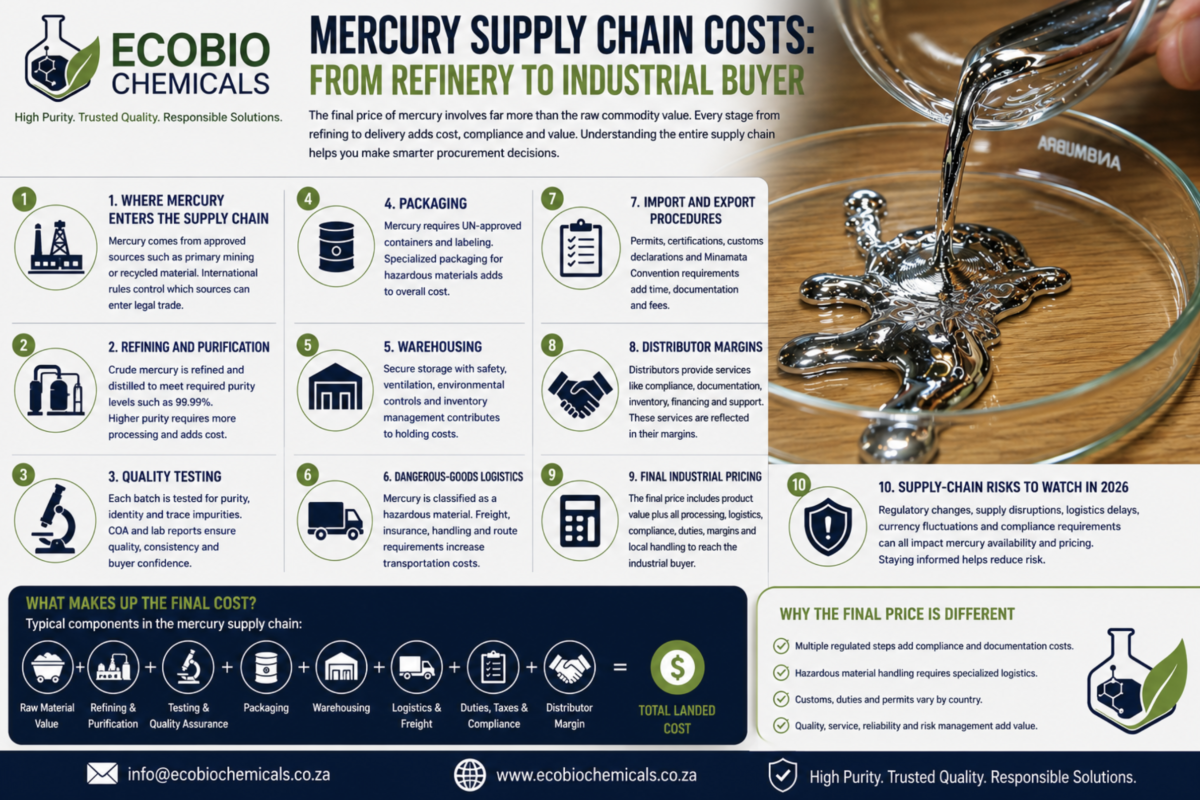
Understanding the mercury supply chain helps procurement teams distinguish between the underlying product value and the additional costs required to move a regulated material from an approved source to an industrial destination.
For industrial buyers, the quoted price of mercury is only one part of the total procurement equation. The final cost can reflect purification, quality testing, packaging, warehousing, dangerous-goods logistics, regulatory documentation, customs, insurance, and other supply-chain expenses.
Because mercury is internationally regulated, supply and trade arrangements can be substantially more complex than those for ordinary industrial commodities. The Minamata Convention specifically addresses mercury supply sources and international trade, including measures intended to control mercury availability and prevent uncontrolled distribution.
1. Where Mercury Enters the Supply Chain
The supply chain can begin with an approved source of mercury, including recovered or recycled material where permitted. The origin of the material is important because international rules can restrict which sources may legally enter trade.
The Minamata Convention places controls on mercury supply sources and trade, including requirements concerning exports and imports. In applicable transactions, written consent from the importing country is part of the international control framework.
Consequently, the commercial value of mercury cannot always be evaluated independently from its origin and regulatory status.
2. Refining and Purification
Where mercury is processed to meet a particular industrial specification, purification can add value and cost.
A buyer requesting a high-purity specification may require additional processing, quality control, and analytical verification compared with a less demanding specification.
For procurement purposes, the important question is not simply whether a supplier describes material as “high purity,” but whether the stated specification is supported by appropriate documentation and testing.
Purity requirements should therefore be established before comparing mercury supplier quotations.
3. Quality Testing
Testing is another component of mercury supply costs.
Industrial buyers may require documentation confirming product identity, purity, batch information, and applicable analytical results. A Certificate of Analysis (COA), for example, can provide information supporting the stated specification.
Testing costs can vary depending on the required analytical methods, number of parameters, laboratory arrangements, and frequency of testing.
For larger industrial procurement programs, consistent batch documentation can be particularly important because purchasing teams need confidence that subsequent deliveries conform to the agreed specification.
4. Packaging
Mercury requires appropriate packaging and handling because of its hazardous characteristics.
Packaging is therefore not simply a matter of choosing the cheapest available container. Applicable transportation rules can specify requirements relating to packaging, marking, labeling, documentation, and handling.
The UN dangerous-goods framework addresses classification, packaging, testing and approval of packagings, as well as consignment procedures such as marking, labeling, placarding, and documentation.
As a result, compliant packaging can form a meaningful component of the final delivered price.
5. Warehousing
Warehousing can also contribute to the cost of the mercury supply chain.
Storage arrangements may need to accommodate hazardous-material requirements, security, inventory controls, documentation, and environmental procedures. The longer material remains within a supply chain, the more storage and inventory-management costs can become relevant.
For buyers, this is one reason that two apparently similar quotations can produce different delivered prices.
6. Dangerous-Goods Logistics
Mercury logistics can be more complex than standard freight.
Transportation regulations are designed to reduce risks to people, property, and the environment and cover different modes of transport. UNECE explains that dangerous-goods systems address transport conditions, classification, packaging, labeling, and documentation.
Consequently, freight pricing may reflect more than distance. Carrier availability, packaging requirements, handling procedures, route restrictions, documentation, insurance, and specialized logistics services can all affect the transportation component.
A lower product quotation does not necessarily mean a lower delivered cost.
7. Import and Export Procedures
International mercury transactions can involve additional regulatory procedures.
The Minamata Convention provides forms and guidance for mercury trade under Article 3, including guidance concerning certification and completion of trade-related forms.
Individual countries can also impose their own customs, environmental, hazardous-material, and import-control requirements.
For an industrial buyer, the relevant calculation is therefore:
Product cost + compliant packaging + freight + insurance + customs + applicable duties/taxes + regulatory costs + local handling = total landed cost
Actual charges vary by transaction and destination.
8. Distributor Margins
Not every industrial buyer purchases directly from the original source.
A distributor or specialized supplier may provide additional services such as inventory holding, quality verification, packaging, documentation, customer support, and logistics coordination.
These services are reflected in the supplier’s commercial margin.
A distributor quotation can therefore be higher than an underlying commodity reference while still providing greater value to a buyer who needs ready availability, documentation, and compliant delivery.
When comparing mercury pricing, buyers should compare equivalent services rather than looking only at the headline price.
9. Final Industrial Pricing
The final industrial price is effectively the result of multiple layers of the supply chain.
A simplified structure may look like:
Source value → purification → testing → packaging → storage → logistics → regulatory processing → customs → local handling → supplier margin → delivered industrial price
Not every transaction contains every cost category, and the relative importance of each component can vary considerably.
This explains why there is rarely a single universal mercury price applicable to every buyer, destination, purity specification, packaging configuration, or delivery term.
For procurement teams, mercury supply costs should therefore be evaluated using a total-cost approach.
10. Supply-Chain Risks to Watch in 2026
Industrial buyers should monitor several factors affecting the mercury supply chain during 2026.
Regulatory changes
International controls continue to evolve. The Minamata Convention is conducting ongoing work concerning mercury supply sources and trade, including efforts to address implementation challenges and illegal trade.
Availability
Restrictions on certain sources can influence the pool of legally available supply.
Logistics
Changes to dangerous-goods transportation requirements can affect packaging, routing, carrier availability, and freight costs. UNECE’s dangerous-goods framework continues to be updated, including amendments scheduled for future ADR implementation.
Currency
International transactions may be affected by exchange-rate movements between the supplier’s currency and the buyer’s purchasing currency.
Compliance
Additional permits, documentation, inspections, or approvals can affect both lead times and procurement costs.
Conclusion
The mercury supply chain extends far beyond the initial value of the material. Refining, quality testing, compliant packaging, warehousing, dangerous-goods transportation, regulatory procedures, customs, and supplier services can all contribute to the final industrial price.
For buyers, the most useful approach is to compare quotations on a total landed-cost basis rather than selecting a supplier solely on the lowest advertised price.
A well-structured procurement evaluation should confirm the product specification, documentation, regulatory status, packaging, delivery terms, freight, insurance, customs requirements, and all other applicable charges.
In 2026, regulatory developments remain an important factor to monitor. The Minamata Convention continues work relating to mercury supply and trade, while dangerous-goods transportation frameworks are also evolving.
Ultimately, understanding mercury logistics, mercury supplier costs, and mercury pricing gives industrial procurement teams a clearer picture of why the final customer price can differ substantially from the underlying commodity value.