
High purity Acrylamide
Acrylamide vs Bis-Acrylamide: What you should know 2026
Aug
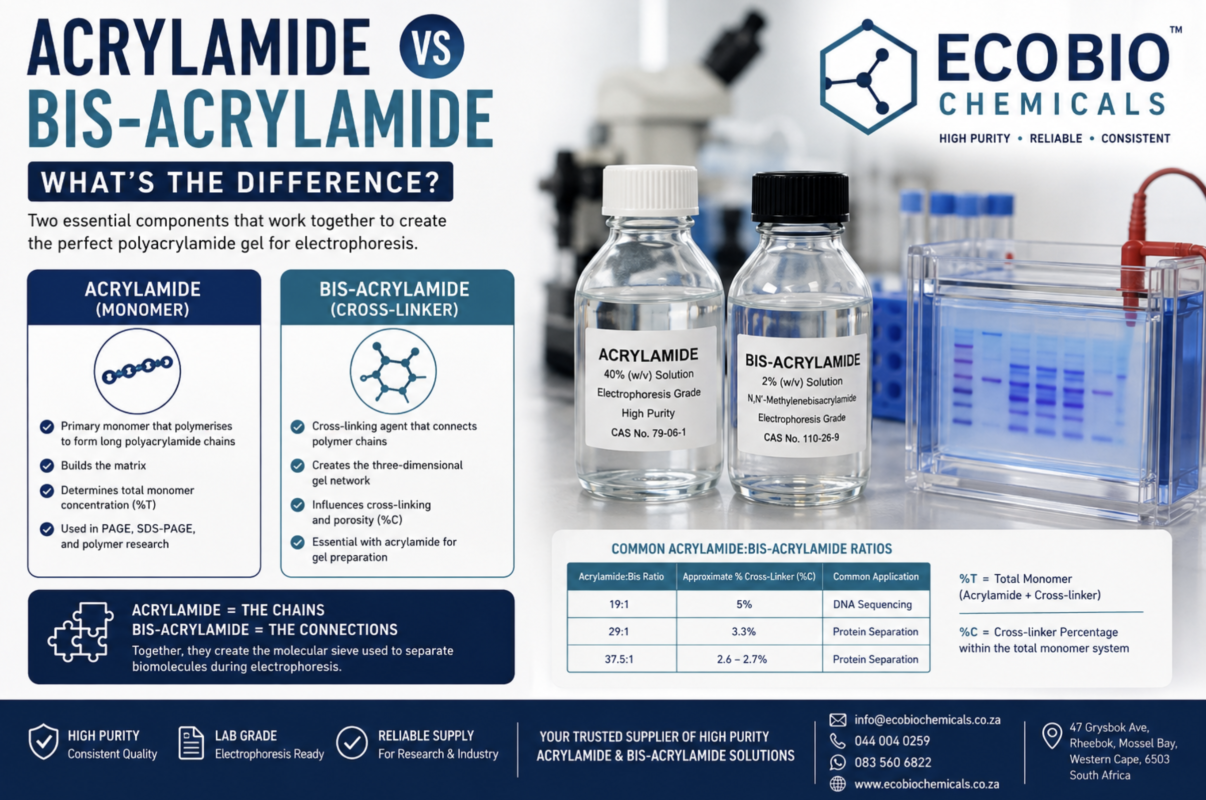
Acrylamide vs Bis-Acrylamide – What’s the Difference?
Learn the difference between acrylamide and bis-acrylamide, how they work together in polyacrylamide gel electrophoresis, their functions, ratios, applications and key buying considerations.
When working with polyacrylamide gel electrophoresis, SDS-PAGE or other laboratory separation techniques, two chemicals frequently appear together: acrylamide and bis-acrylamide. Although they are closely related and often supplied as premixed solutions, they perform different functions in the formation of a polyacrylamide gel.
The Key Difference: Monomer vs Cross-Linker
The simplest way to understand the difference is this:
- Acrylamide is the primary monomer that polymerises to form long polyacrylamide chains.
- Bis-acrylamide, formally known as N,N’-methylenebisacrylamide, acts as the cross-linking agent that connects those polymer chains into a three-dimensional gel network.
The amount of acrylamide and bis-acrylamide used affects the structure and porosity of the final gel.
What Is Acrylamide?
Acrylamide is the main building block used to create the polyacrylamide matrix. During polymerisation, acrylamide molecules join together to form long chains.
In electrophoresis, the concentration of total monomer is one of the important factors affecting gel pore size. Bio-Rad describes polyacrylamide gels using %T, representing total monomer concentration, and %C, representing the proportion of cross-linker.
Common Acrylamide Applications
High purity acrylamide is used in:
- SDS-PAGE
- Native PAGE
- Protein separation
- DNA electrophoresis
- RNA electrophoresis
- Molecular biology research
- Polyacrylamide gel preparation
- Polymer and chemical research
The purity of electrophoresis reagents can influence the uniformity and reproducibility of the resulting gel matrix.
What Is Bis-Acrylamide?
Bis-acrylamide is the cross-linking component of the system. Its molecular structure allows it to connect different growing polyacrylamide chains, producing the interconnected network that gives the gel its physical structure.
Without an appropriate cross-linking component, polymerised acrylamide would not produce the same three-dimensional gel matrix required for conventional polyacrylamide gel electrophoresis.
Acrylamide vs Bis-Acrylamide: Quick Comparison
| Feature | Acrylamide | Bis-Acrylamide |
|---|---|---|
| Primary role | Monomer | Cross-linker |
| Main function | Forms polymer chains | Connects polymer chains |
| Role in gel structure | Builds the matrix | Creates the network |
| Effect on gel design | Helps determine total monomer concentration | Influences cross-linking and porosity |
| Common use | PAGE, SDS-PAGE and polymer research | Polyacrylamide gel preparation |
| Usually used alone? | Can be supplied separately | Typically used with acrylamide for gel preparation |
How Acrylamide and Bis-Acrylamide Work Together
During gel preparation, acrylamide and bis-acrylamide are combined in a selected ratio. Polymerisation then creates a cross-linked polyacrylamide network.
Commercial premixed products are widely available. For example, a 40% acrylamide/bis-acrylamide solution with a 37.5:1 ratio contains the two components premixed for preparing protein and DNA gels.
The ratio matters because changing the amount of cross-linker changes the properties of the gel network.
A useful way to think about the system is:
Acrylamide = the chains
Bis-acrylamide = the connections between the chains
Together, they create the molecular sieve used to separate biomolecules during electrophoresis.
Understanding Acrylamide/Bis-Acrylamide Ratios
Acrylamide and bis-acrylamide are commonly supplied in ratios such as:
- 19:1
- 29:1
- 37.5:1
These figures refer to the ratio of acrylamide to bis-acrylamide.
For example:
37.5:1 means there are 37.5 parts acrylamide for every 1 part bis-acrylamide.
Bio-Rad lists common cross-linker percentages and applications for these ratios:
| Acrylamide:Bis Ratio | Approximate % Cross-Linker | Common Application |
|---|---|---|
| 19:1 | 5% | DNA sequencing |
| 29:1 | 3.3% | Protein separation |
| 37.5:1 | 2.6–2.7% | Protein separation |
These are common commercial formulations, but the appropriate ratio should be selected according to the specific experimental method and application.
What Are %T and %C?
When discussing polyacrylamide gels, two important terms are %T and %C.
%T – Total Monomer Concentration
%T represents the total concentration of acrylamide plus cross-linker in the final gel.
A higher total monomer concentration generally produces a tighter gel matrix, affecting which molecule sizes can be effectively separated.
%C – Cross-Linker Percentage
%C represents the percentage of cross-linker relative to the total amount of acrylamide and cross-linker.
Bio-Rad defines the relationship as:
- %T: total acrylamide + cross-linker concentration
- %C: percentage of cross-linker within that total monomer system
Together, %T and %C help determine the characteristics of the polyacrylamide gel matrix.
How Does the Ratio Affect Gel Pore Size?
The acrylamide concentration and the acrylamide-to-bis-acrylamide ratio both influence the porosity of the gel.
In general, changing total monomer concentration changes the density of the gel matrix, while changing the amount of bis-acrylamide changes the degree and pattern of cross-linking.
Thermo Fisher specifically notes that the ratio of bis-acrylamide to acrylamide modulates polyacrylamide gel porosity.
This is why selecting the correct formulation is important when separating molecules of different sizes.
Acrylamide vs Bis-Acrylamide for SDS-PAGE
SDS-PAGE is one of the most common applications where acrylamide and bis-acrylamide are used together.
A polyacrylamide gel provides a molecular sieving matrix that allows proteins to be separated during electrophoresis.
Commercial SDS-polyacrylamide gel systems may use a 40% acrylamide:bis-acrylamide 37.5:1 stock solution to prepare resolving gels across a range of acrylamide concentrations.
The final gel percentage is selected according to the size range of the proteins being analysed.
For example, a laboratory may use different gel formulations when working with:
- Large proteins
- Medium-sized proteins
- Small proteins
- Peptides
The appropriate gel composition should be selected using a validated laboratory protocol for the specific analytical objective.
Acrylamide vs Bis-Acrylamide for DNA and RNA Applications
Acrylamide/bis-acrylamide gels are also used in nucleic acid applications.
Different ratios can be selected depending on the method and desired separation characteristics. Bio-Rad identifies the 19:1 ratio as a common formulation for DNA sequencing, while 29:1 and 37.5:1 formulations are commonly associated with protein separation applications.
Because experimental requirements can vary significantly, researchers should follow validated procedures for their particular DNA or RNA application rather than assuming one ratio is universally suitable.
Acrylamide Powder vs Premixed Acrylamide/Bis-Acrylamide
Laboratories can generally choose between separate raw materials and premixed formulations.
Separate Acrylamide and Bis-Acrylamide
Buying the chemicals separately may provide greater flexibility.
Potential advantages include:
- Adjustable ratios
- Custom gel formulations
- Flexibility for different research applications
- Control over stock preparation
This may be useful for laboratories developing or modifying specific electrophoresis protocols.
Premixed Acrylamide/Bis-Acrylamide Solutions
Premixed solutions are designed for convenience and consistency.
Common commercial products include:
- 30% solutions
- 40% solutions
- 19:1 ratio
- 29:1 ratio
- 37.5:1 ratio
Bio-Rad lists ready-to-use acrylamide solutions in multiple concentrations and ratios, while Thermo Fisher offers premixed 40% solutions at a 37.5:1 ratio.
For laboratories performing routine analyses, premixed products may simplify stock preparation. Separate reagents may be preferable when greater formulation flexibility is required.
Which Is More Important: Acrylamide or Bis-Acrylamide?
Neither chemical should be viewed as universally “more important” because they perform different but complementary functions.
Acrylamide provides the primary polymer-forming component.
Bis-acrylamide provides the cross-links needed to create the three-dimensional network.
The correct balance between them depends on the required gel properties and intended separation.
A poorly selected ratio can alter the structure of the matrix and therefore affect the separation characteristics of the gel.
How to Choose the Right Acrylamide/Bis-Acrylamide Product
Before purchasing, consider the following:
1. Application
Identify whether the product will be used for:
- SDS-PAGE
- Native PAGE
- Protein separation
- DNA analysis
- RNA analysis
- DNA sequencing
- General research
2. Purity
For sensitive laboratory work, check the purity and application specifications of the exact product.
Bio-Rad, for example, offers acrylamide and bis-acrylamide electrophoresis reagents specified at 99.9% purity.
3. Ratio
Confirm whether your method requires:
- 19:1
- 29:1
- 37.5:1
- Another specified ratio
4. Product Format
Choose between:
- Individual powders
- Premixed powders
- Ready-to-use solutions
5. Technical Documentation
Request:
- Certificate of Analysis (COA)
- Safety Data Sheet (SDS)
- Product specification
- Technical data sheet
Safety Considerations When Handling Acrylamide and Bis-Acrylamide
Acrylamide-containing products can present significant hazards. For example, a current Thermo Fisher product listing for a 40% acrylamide/bis-acrylamide solution identifies multiple serious health hazard classifications and transport requirements.
Laboratories should therefore:
- Review the SDS for the exact product
- Follow institutional safety procedures
- Use appropriate engineering controls and PPE
- Ensure personnel are appropriately trained
- Follow applicable storage, spill-response and waste-disposal requirements
Safety procedures should always be based on the current SDS and local workplace requirements, rather than a general blog article.
Conclusion: Acrylamide and Bis-Acrylamide Are Different but Work Together
The difference between acrylamide and bis-acrylamide is straightforward once their roles are understood.
Acrylamide is the main monomer that forms the polyacrylamide chains. Bis-acrylamide is the cross-linker that connects those chains and creates the three-dimensional gel network.
By adjusting:
- Acrylamide concentration
- Bis-acrylamide concentration
- Acrylamide-to-bis-acrylamide ratio
researchers can modify the characteristics of the polyacrylamide gel matrix for different electrophoresis applications.
Whether you are purchasing high purity acrylamide, bis-acrylamide, or a premixed acrylamide/bis-acrylamide solution, always confirm the product’s purity, ratio, concentration, intended application and available technical documentation before placing an order.
For laboratories and research institutions in South Africa, sourcing the correct electrophoresis-grade product can help support consistent workflows and reproducible results.
- Buy High Purity Acrylamide
- High Purity Acrylamide Supplier in South Africa
- Acrylamide for Gel Electrophoresis
- Request an Acrylamide Quote
- View Acrylamide Product Specifications