
Magnesium Sulphate
Magnesium Sulphate Price Per Kg: A Buyer’s Guide 2026
Aug
Searching for the magnesium sulphate price per kg is a common starting point for procurement managers, manufacturers, distributors, agricultural businesses, laboratories, and other commercial buyers. However, the price per kilogram only becomes useful when the products being compared have the same specification, grade, quantity, packaging, and delivery requirements.
Magnesium sulphate is available in different chemical forms and purity levels. As a result, two suppliers can quote very different prices while both accurately describing their products as magnesium sulphate.
For businesses looking to purchase magnesium sulphate efficiently, the objective should not simply be to find the lowest advertised price. Instead, buyers should establish the exact product specification and compare like-for-like quotations.
1. Why Magnesium Sulphate Price Per Kg Varies
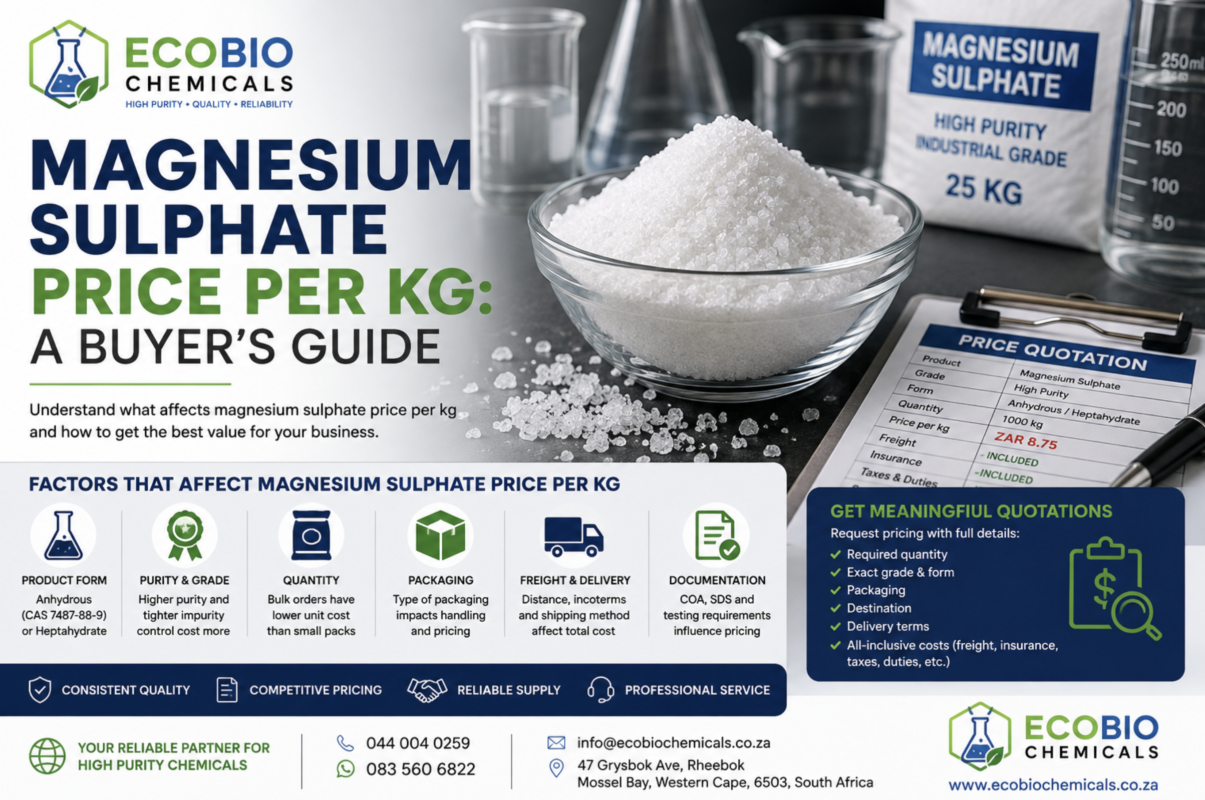
The magnesium sulphate price per kg can be influenced by numerous factors, including chemical form, purity, quantity, packaging, testing, supplier location, freight, and market conditions.
A small laboratory pack, for example, will normally have a substantially different unit cost from a pallet or bulk industrial order. Packaging, handling, administration, and transportation represent a larger proportion of the cost when only a small quantity is purchased.
For this reason, an online price should generally be treated as an indication rather than a universal market price.
2. Anhydrous vs Hydrated Magnesium Sulphate
One of the most important factors when comparing magnesium sulphate per kilogram is the exact chemical form.
Magnesium sulphate may be supplied as anhydrous magnesium sulphate or as hydrated forms such as magnesium sulphate heptahydrate. These forms differ in water content, molecular weight, physical properties, and applications.
Anhydrous magnesium sulphate is associated with CAS 7487-88-9. Buyers should confirm the CAS number, hydration state, assay, and specification before comparing quotations.
A cheaper product is not necessarily cheaper on a specification-adjusted basis if it is a different form from the material required for the application.
3. Purity and Grade
Purity is another major factor affecting magnesium sulphate pricing.
High-purity magnesium sulphate may require tighter manufacturing controls and additional testing compared with standard industrial grades. Buyers may have specific limits for trace metals, moisture, insoluble matter, or other parameters.
The required grade should therefore be established before requesting a quotation.
When comparing suppliers, ask for the actual specification rather than relying on descriptions such as “premium,” “high quality,” or “industrial grade.” A Certificate of Analysis (COA) can provide useful batch-specific information about the material being offered.
4. Order Quantity and Bulk Pricing
The magnesium sulphate bulk price is often different from the price of smaller quantities.
Larger orders can potentially reduce the cost per kilogram because packaging, handling, warehousing, and transportation can be optimized. Suppliers may also offer volume-based pricing for repeat customers or scheduled deliveries.
However, bulk purchasing should be based on genuine consumption requirements. Buying substantially more material than required can create additional storage, inventory, and working-capital costs.
For regular industrial consumption, buyers can request quotations at several quantities to determine where meaningful volume discounts become available.
5. Packaging Costs
Packaging can have a direct effect on the final magnesium sulphate price per kg.
The required packaging depends on quantity, product specification, handling requirements, storage conditions, and transportation arrangements. Smaller quantities may require proportionally more packaging per kilogram, while larger commercial orders can often use more efficient packaging formats.
When requesting prices, specify the desired packaging and ask whether packaging costs are already included in the quoted price.
This prevents buyers from comparing a packaged delivered price with an un-packaged or ex-works quotation.
6. Freight and Delivery Location
Freight is an important part of the total procurement cost.
A supplier offering a low magnesium sulphate wholesale price may not necessarily provide the lowest final cost if the product has to travel a significant distance. Transportation charges can depend on shipment weight, destination, transport method, fuel costs, and delivery requirements.
For domestic and international purchases, buyers should determine whether the quotation includes freight, insurance, customs-related charges, taxes, duties, and local handling.
The most useful figure for procurement purposes is often the total delivered cost, rather than the basic product price.
7. Supplier Location and Market Conditions
Supplier location can influence pricing through production costs, warehouse availability, raw-material sourcing, energy costs, labor, and logistics.
Market conditions can also change over time. Transportation costs, availability of raw materials, production capacity, currency movements, and regional demand may all influence commercial quotations.
This means buyers should request current quotations rather than assuming that an old price remains valid.
8. COA, SDS and Technical Documentation
Professional chemical procurement should include appropriate documentation.
Depending on the application and grade, buyers may request a Certificate of Analysis (COA), Safety Data Sheet (SDS), product specification sheet, batch information, and other technical documentation.
Documentation can be particularly important when the material is being used in a controlled manufacturing or quality-management environment.
A supplier that clearly identifies the chemical form, purity, packaging, and supporting documentation makes it easier for procurement teams to conduct an accurate comparison.
9. How to Compare Magnesium Sulphate Quotations
When requesting a quotation from a magnesium sulphate supplier, provide the same requirements to every supplier.
A useful comparison should include:
- Exact chemical form
- Purity or assay
- CAS number
- Required quantity
- Packaging
- COA requirements
- SDS availability
- Price per kilogram
- Freight charges
- Delivery destination
- Delivery terms
- Lead time
- Payment terms
- Taxes and applicable charges
The formula is straightforward:
Product price + packaging + freight + insurance + applicable charges = total procurement cost
This approach makes supplier quotations much easier to compare.
10. Getting Better Value From Your Purchase
The best magnesium sulphate purchase is not necessarily the quotation with the lowest headline price. Consistent quality, reliable documentation, appropriate packaging, predictable lead times, and dependable supply can all contribute to the overall value of a supplier relationship.
Businesses purchasing regularly may also benefit from discussing scheduled deliveries, volume pricing, and longer-term supply arrangements with qualified suppliers.
Conclusion
The magnesium sulphate price per kg depends on much more than the chemical itself. Product form, purity, quantity, packaging, freight, supplier location, documentation, and market conditions can all influence the final price.
Before purchasing, buyers should define their exact requirements and request comparable quotations based on the same specification. Comparing magnesium sulphate bulk price, wholesale pricing, freight, and total delivered cost provides a much more accurate picture of the true value of each offer.
For industrial procurement, the right approach is simple: compare specification first, price second, and total delivered cost last.