
Silver mercury
Mercury Procurement 2026 Guide for Industrial Buyers
Aug
Mercury is subject to significant international controls. The Minamata Convention on Mercury regulates mercury supply sources and international trade, including controls concerning imports and exports. Applicable national laws can add further requirements.
For procurement managers, the objective should therefore be to establish a compliant and technically justified purchasing process before requesting or accepting quotations.
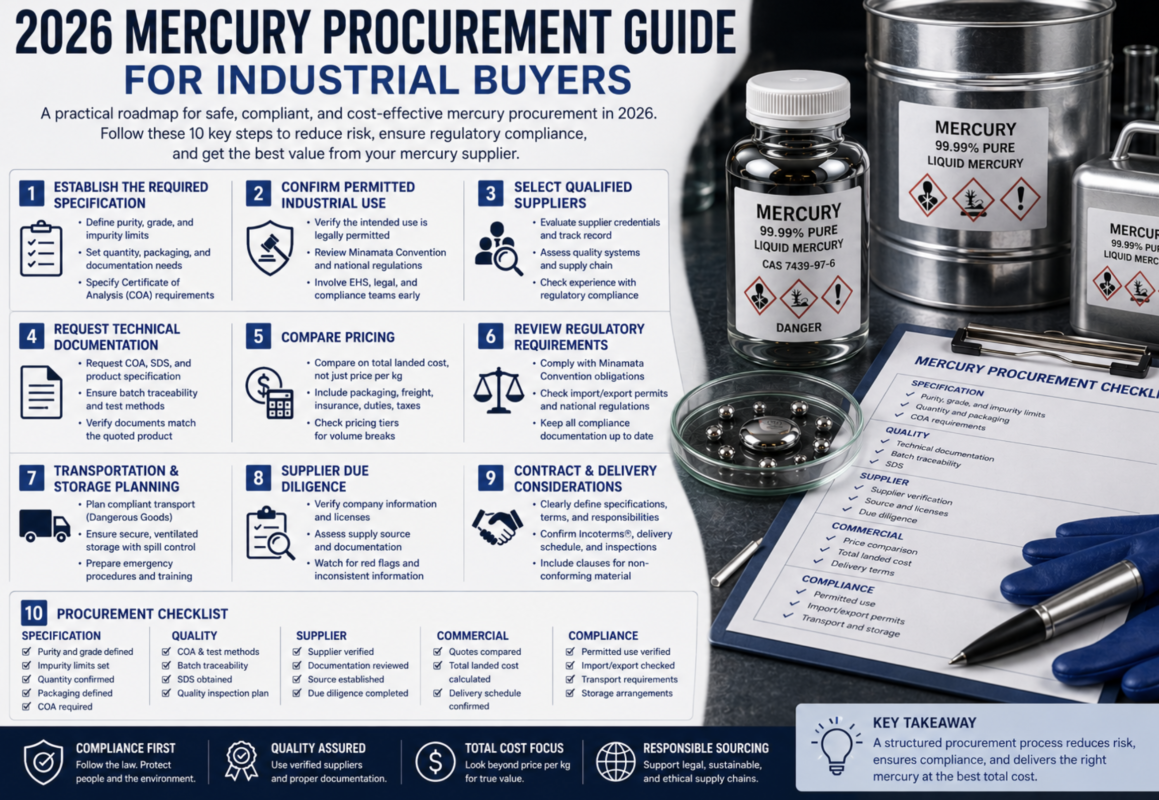
1. Establishing the Required Specification
The first step in mercury procurement 2026 is defining exactly what the organization requires.
A procurement specification may include:
- Chemical identity
- Required purity
- Relevant impurity limits
- Quantity
- Packaging requirements
- Batch documentation
- Certificate of Analysis (COA)
- Safety documentation
- Delivery destination
- Required delivery schedule
Avoid using general descriptions such as “pure mercury” as the complete purchasing specification. If a particular purity is required, it should be clearly stated and supported by appropriate analytical documentation.
A precise specification allows procurement teams to obtain genuinely comparable quotations.
2. Confirming Permitted Industrial Use
Before approaching a mercury supplier, buyers should establish that the intended application and transaction are legally permitted.
The Minamata Convention includes provisions controlling mercury supply sources and trade, and Parties are required to implement measures governing mercury imports and exports. The Convention also restricts certain mercury-added products and manufacturing processes.
This means procurement should involve the organization’s environmental, health-and-safety, legal, and compliance teams where appropriate.
The intended use should be documented before commercial negotiations progress.
3. Selecting Qualified Suppliers
Supplier selection should focus on more than price.
A qualified supplier should be able to demonstrate appropriate business credentials, product traceability, technical documentation, and compliance with applicable requirements.
Procurement teams can evaluate:
- Company identity and operating history
- Product documentation
- Quality-control procedures
- Batch traceability
- Safety documentation
- Relevant regulatory experience
- Ability to meet contractual requirements
- References or established commercial credentials where appropriate
The purpose of supplier qualification is to reduce the risk of receiving material that does not match the agreed specification or documentation.
4. Requesting Technical Documentation
A professional quotation should be supported by appropriate technical information.
Depending on the specification, buyers may request a Certificate of Analysis, Safety Data Sheet, product specification sheet, batch information, packaging details, and other documents required by their internal quality system.
The COA should be reviewed carefully. Buyers should determine whether it is batch-specific, what purity was measured, which analytical methods were used, and whether the reported results correspond to the product being quoted.
Good documentation creates traceability between the supplier, batch, shipment, and receiving organization.
5. Comparing Pricing
Price comparisons should be conducted on an equivalent basis.
A quotation stating a low price per kilogram may exclude packaging, freight, insurance, documentation, taxes, duties, or other charges.
A useful comparison therefore looks at:
Product price + packaging + freight + insurance + duties/taxes + applicable handling and compliance costs = total landed cost
Buyers should also confirm the quoted quantity and whether the price changes with order volume.
A mercury pricing guide should be viewed as a framework for comparing offers rather than as a universal market price. Supplier quotations can vary because of specification, origin, availability, logistics, currency, and commercial terms.
6. Reviewing Regulatory Requirements
Regulatory review should take place before a purchase order is finalized.
International mercury trade is controlled under the Minamata Convention. The Convention’s trade framework includes requirements concerning the source of mercury and the consent of importing countries in applicable transactions.
UNEP also emphasizes that secure storage and environmentally sound management are important components of reducing mercury-related risks.
Because national requirements vary, buyers should verify the rules applicable to the specific origin, destination, quantity, intended use, and transaction structure.
7. Transportation and Storage Planning
Mercury transportation and storage should be treated as part of procurement planning rather than an afterthought.
The buyer should establish appropriate arrangements for receiving, handling, storage, inventory control, spill prevention, and emergency procedures.
Transportation arrangements should also account for applicable dangerous-goods requirements and documentation.
Importantly, procurement teams should confirm these requirements before agreeing to delivery terms. A supplier’s ability to sell a material does not automatically mean the buyer is authorized to import, store, or use it.
8. Supplier Due Diligence
Due diligence is particularly important when sourcing regulated hazardous materials.
Procurement teams should check whether the supplier’s company information, product documentation, commercial terms, and regulatory statements are consistent.
Red flags can include:
- Unusually incomplete documentation
- Refusal to identify the product specification
- Inconsistent batch information
- Pressure to bypass normal compliance procedures
- Unclear origin
- Unverifiable company information
- Commercial terms that do not clearly identify responsibilities
A low price should never be used as a reason to overlook missing compliance information.
9. Contract and Delivery Considerations
Once a qualified supplier has been identified, the contract should clearly define the agreed commercial and technical requirements.
Important areas can include:
- Product specification
- Quantity and tolerances
- Packaging
- Documentation
- Delivery terms
- Delivery schedule
- Inspection requirements
- Payment terms
- Responsibilities for freight and insurance
- Applicable regulatory obligations
- Procedures for non-conforming material
Procurement teams should also make sure that the final commercial contract matches the quotation and technical specification.
Clear documentation can prevent disputes later in the supply process.
10. Procurement Checklist
Before completing an industrial mercury purchase, procurement managers can use the following checklist:
Specification
- Product identity confirmed
- Required purity established
- Relevant impurity limits established
- Quantity confirmed
- Packaging requirements defined
Quality
- COA requirements established
- Batch traceability confirmed
- Analytical information reviewed
- SDS obtained
Supplier
- Supplier identity verified
- Documentation reviewed
- Supply origin established
- Appropriate due diligence completed
Commercial
- Multiple quotations compared where appropriate
- Pricing basis confirmed
- Freight identified
- Insurance responsibility established
- Total landed cost calculated
- Delivery schedule confirmed
Compliance
- Intended use reviewed
- Import/export requirements checked
- Applicable national regulations reviewed
- Transportation requirements confirmed
- Storage arrangements confirmed
Conclusion – Mercury Procurement 2026
Effective mercury procurement 2026 is fundamentally a risk-management and specification exercise, not simply a search for the lowest price.
Industrial buyers should begin by defining the required product specification and confirming that the intended use and transaction are permitted. From there, supplier qualification, technical documentation, pricing comparisons, regulatory review, transportation planning, and contractual controls should form part of a single procurement process.
The international regulatory environment makes this particularly important. The Minamata Convention continues to emphasize controls over mercury supply and trade, while UNEP highlights the importance of reducing mercury supply and ensuring secure, environmentally sound management.
For procurement managers, the best purchasing decision is therefore not necessarily the cheapest quotation. It is the offer that provides the required specification, reliable documentation, compliant supply chain, appropriate delivery arrangements, and transparent total cost.
That approach gives industrial buyers a stronger foundation for responsible and efficient mercury purchasing in 2026.