
Silver mercury
Silver Mercury 99.99%: Understanding Quality, Purity, and Price
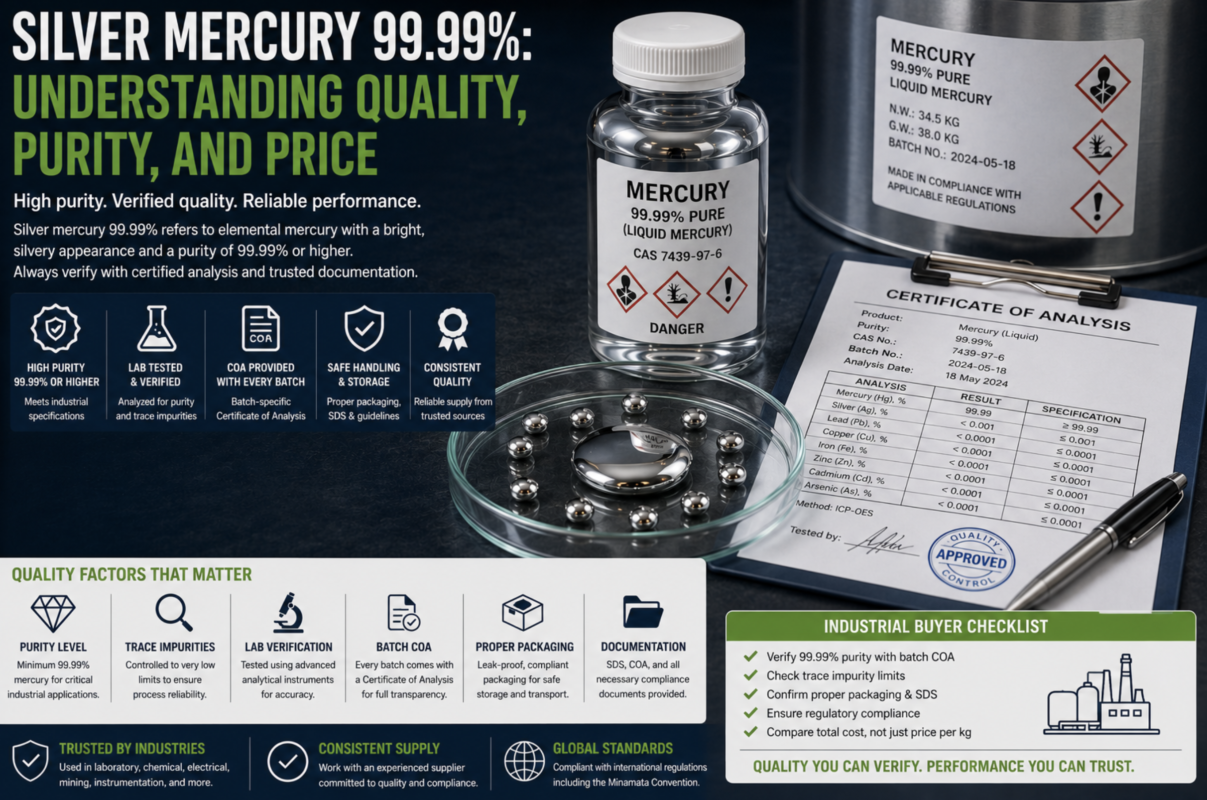
Aug
When industrial buyers search for silver mercury 99.99, they are generally looking for high-purity elemental mercury described by its characteristic silver-colored appearance and a stated purity of 99.99%. However, commercial terminology can sometimes create confusion. The words “silver mercury” may describe appearance rather than establish a particular grade, purity, or quality standard.
For procurement professionals, the most reliable approach is to look beyond product descriptions and verify the actual technical specification, analytical results, documentation, and applicable regulatory requirements.
1. What Buyers Mean by “Silver Mercury”
The term silver mercury is commonly used in commercial searches to describe elemental mercury because the material has a distinctive bright, silvery appearance.
It is important to understand that “silver mercury” does not by itself establish a purity level. A product described as silver mercury could have different specifications depending on the supplier and intended application.
When a buyer specifically requires 99.99% mercury, the quotation should clearly state the purity specification and provide supporting documentation.
The correct approach is therefore to treat “silver mercury” as a product description and 99.99% as a technical specification that must be verified.
2. Mercury Purity Specifications
A 99.99% specification represents a high-purity requirement. In practical procurement, however, the headline purity figure should not be considered in isolation.
Buyers should review the complete specification, including applicable limits for relevant trace impurities and the analytical method used to establish the result.
A professional product specification may identify:
- Product name
- Chemical identity
- CAS number
- Purity requirement
- Trace impurity limits
- Analytical methodology
- Batch identification
- Packaging specification
- Documentation supplied
This information creates a much stronger basis for evaluating mercury quality than a product title alone.
3. Physical Appearance vs Actual Purity
One of the most important distinctions for buyers is the difference between appearance and analytical purity.
Elemental mercury is naturally recognized by its reflective, silvery appearance. However, visual appearance cannot reliably establish whether a material meets a 99.99% purity specification.
A visually clean or highly reflective sample should not automatically be considered high purity.
For industrial procurement, purity should be established through appropriate testing and documentation. This is particularly important when the material is being purchased against a defined technical specification.
In other words, appearance can help identify the material, but laboratory analysis establishes the specification.
4. Laboratory Verification
Laboratory testing provides the technical foundation for verifying high-purity material.
Depending on the applicable specification, analytical procedures can be used to determine overall purity and assess relevant trace elements or impurities.
Buyers should understand what analytical method has been used and whether the reported result corresponds to the material or batch being purchased.
Where quality is critical, procurement and quality-control teams may establish incoming inspection or independent verification procedures appropriate to their organization.
This helps ensure that the product received corresponds to the agreed specification.
5. COA Information
A Certificate of Analysis (COA) is an important document when evaluating 99.99% mercury.
A useful COA should provide information that allows the buyer to connect the analytical result to the supplied material. Depending on the supplier’s quality system and specification, this can include:
- Product identification
- Batch or lot number
- Stated purity
- Analytical result
- Specification limits
- Test date
- Analytical method
- Quality-control information
Buyers should distinguish between a batch-specific COA and a generic certificate.
A generic document may describe a product family, whereas batch-specific documentation provides more direct evidence regarding the material being supplied.
6. Trace Impurity Limits
High-purity procurement is often about controlling what is present in very small quantities, not simply confirming the headline purity.
For example, a buyer may have requirements concerning particular trace metals or other contaminants. The importance of those impurities depends on the legitimate technical application and its specification.
Consequently, two products advertised as “99.99%” should not automatically be treated as technically identical.
A meaningful comparison should examine the applicable impurity limits, analytical methods, and quality documentation.
This is especially important when comparing quotations from different suppliers.
7. Packaging and Storage Documentation
Quality does not end with the analytical specification.
Mercury is a hazardous substance, so appropriate packaging, labeling, handling, transportation, and storage documentation are important considerations for industrial buyers.
Suppliers should provide appropriate safety documentation, including an SDS, and buyers should ensure that their own storage and handling arrangements comply with applicable requirements.
Packaging requirements may also affect the commercial cost of the material.
For international transactions, buyers should additionally confirm applicable transport and import/export requirements before proceeding.
8. How Quality Influences Pricing
Higher-quality specifications can influence the commercial price because meeting tighter requirements may involve additional purification, testing, quality assurance, certification, specialized packaging, and documentation.
However, buyers should avoid assuming that a higher advertised purity automatically represents better value.
The appropriate question is:
Does the specification meet the buyer’s actual technical requirements?
If a particular application requires 99.99% material and defined impurity limits, paying for verified compliance can provide significant value. If the application does not require that level of purity, purchasing a higher specification may not provide an economic advantage.
For procurement teams, price should therefore be evaluated alongside verified quality.
9. Avoiding Misleading Product Descriptions
Commercial searches can produce a wide range of terminology, including:
- Silver mercury
- Pure mercury
- High-purity mercury
- 99.99% mercury
- Liquid mercury
- Refined mercury
- Industrial mercury
These terms should not automatically be assumed to represent identical specifications.
Before evaluating a quotation, buyers should ask for the formal product specification and supporting documentation.
A credible commercial comparison should establish the product identity, purity, relevant impurity limits, quantity, packaging, delivery terms, documentation, and applicable regulatory requirements.
Mercury is also subject to international controls under the Minamata Convention, including provisions concerning supply sources and international trade. National regulations may impose additional requirements.
10. Industrial Buyer Checklist
Before approving a purchase of material advertised as silver mercury 99.99, industrial procurement teams should consider the following checklist:
Product
- Confirm chemical identity.
- Confirm the required purity.
- Confirm relevant impurity specifications.
- Verify the CAS number and product identification.
Quality
- Request a batch-specific COA where appropriate.
- Review the analytical method.
- Confirm that reported results meet the agreed specification.
Documentation
- Obtain the SDS.
- Confirm applicable technical and regulatory documentation.
- Check that documentation corresponds to the supplied material.
Commercial
- Compare equivalent specifications.
- Review packaging costs.
- Examine delivery terms and freight arrangements.
- Calculate the complete delivered cost rather than relying only on the quoted unit price.
Compliance
- Confirm applicable storage, handling, transportation, import, and export requirements.
- Ensure the intended transaction complies with applicable national and international regulations.
Conclusion
The term silver mercury 99.99 is widely used in commercial searches, but buyers should distinguish product terminology from verified technical specifications. The silver appearance of elemental mercury does not establish purity, and a claim of 99.99% purity should be supported by appropriate analytical documentation.
For industrial buyers, the strongest procurement process combines verified purity, trace impurity information, batch documentation, appropriate packaging, safety information, transparent pricing, and regulatory compliance.
Ultimately, the best measure of mercury quality is not how the material looks or how it is described in a listing. It is whether the supplied product can be demonstrated to meet the agreed specification through reliable documentation and appropriate quality-control procedures.